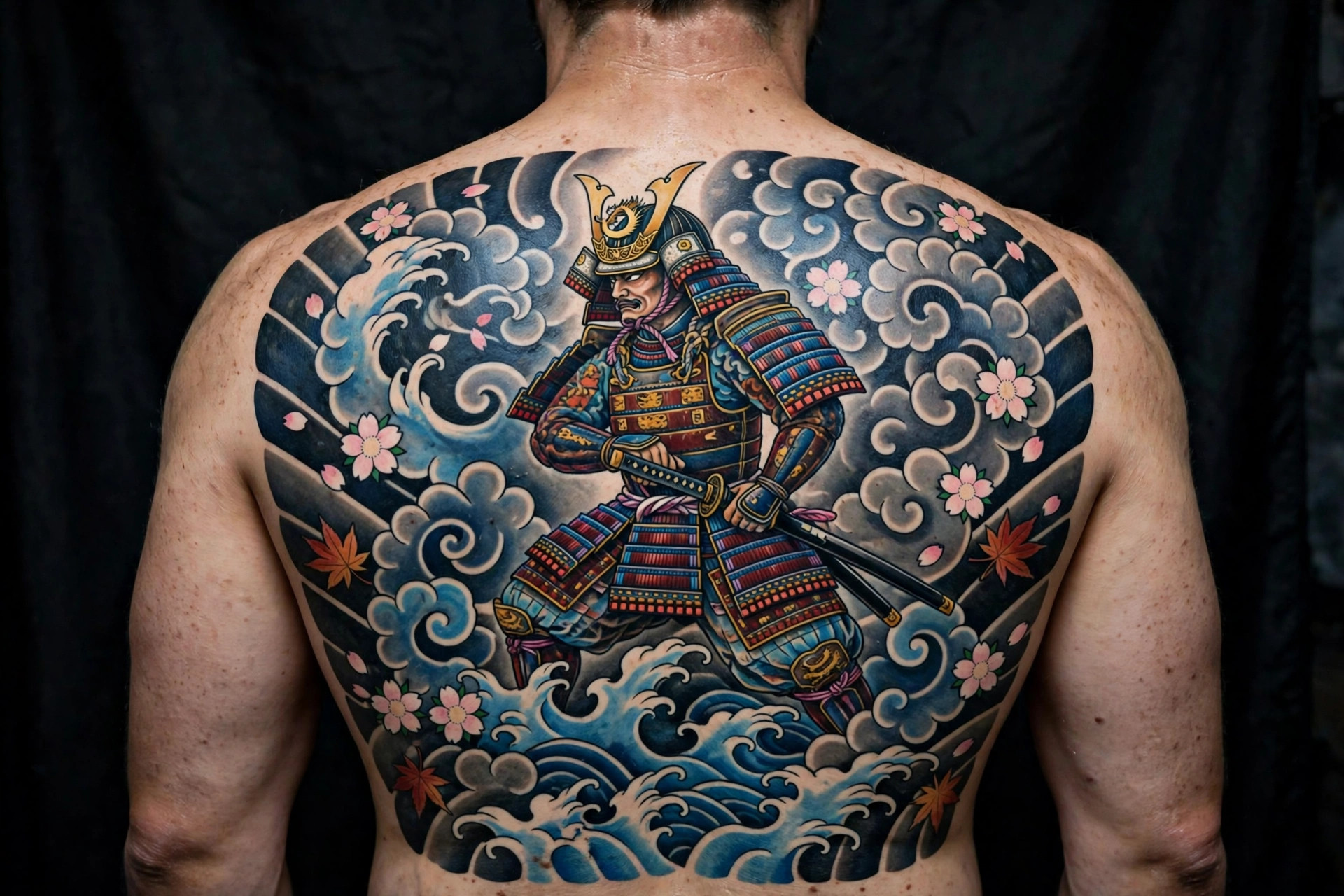
Search for a Japanese tattoo and three words keep taking turns naming the same pictures. One page calls a back piece irezumi, the next calls it wabori, a third calls it horimono, and a reader could reasonably assume the three are rivals, spellings or levels of quality. They are none of those. They are three different kinds of word, doing three different jobs, and once you see which job each one does, the confusion mostly disappears and the right word starts choosing itself.
Tattoos4Everybody
Three words, three jobs, one tattoo
Start with the hub guide to the style itself, then use this page whenever a word needs checking before you use it.
Key Takeaways
- Irezumi is the general word for tattoo, built from parts that mean inserting ink, and in English it often points to the traditional full-body tradition.
- Wabori names Japanese-style tattooing, and it only makes full sense against its partner term yobori, which names Western-style tattooing.
- Horimono comes from carving and engraving, and it points to the tattooed work itself, the finished carved thing on the body.
- The three words overlap because one finished piece can honestly be described by all three at once, each from a different angle.
- The safe habit is simple: use irezumi for tattoo in general, wabori for the style, and horimono for the work as a carved object.
Table of Contents
- The short answer first
- Irezumi: inserting ink
- Wabori: the Japanese style, set against yobori
- Horimono: the carved thing itself
- Why the hori root keeps appearing
- How the three words overlap
- Which word to use when
- Common mix-ups, sorted one by one
- How to talk to an artist using these words
- Our view
- Frequently asked questions
The short answer first
If you remember one sentence, make it this one: irezumi says tattoo, wabori says which style, and horimono says the carved work itself. Everything else in this guide is support for that sentence. The three words are not ranked, they are not interchangeable labels for the same idea, and they are not three spellings that drifted apart over time. Each one answers a different question a person might ask about the same piece of skin.
Ask what the thing is, in plain general terms, and the answer is a tattoo, which is what irezumi covers. Ask what kind of tattooing it is, Japanese or Western in its methods and look, and you are in wabori territory. Ask what to call the finished work as an object, something made by cutting a design into a surface, and horimono is the word that fits. Our hub guide to wabori tattoo covers the style as a whole, while this page stays deliberately narrow and sorts only the words.
That narrowness matters, because most confusion comes from pages that answer all three questions at once without saying so. A caption that calls a photograph irezumi may be using the general word. A studio page that calls the same photograph wabori is talking about style. A collector who calls it horimono is talking about the work as a made thing. All three can be right in the same breath, which is why arguing about which single word is correct usually misses the point. The Pitt Rivers Museum at Oxford uses irezumi for the full-body art form it documents, and the irezumi overview in general reference use does the same, because both are answering the first question, what the thing is.
Irezumi: inserting ink
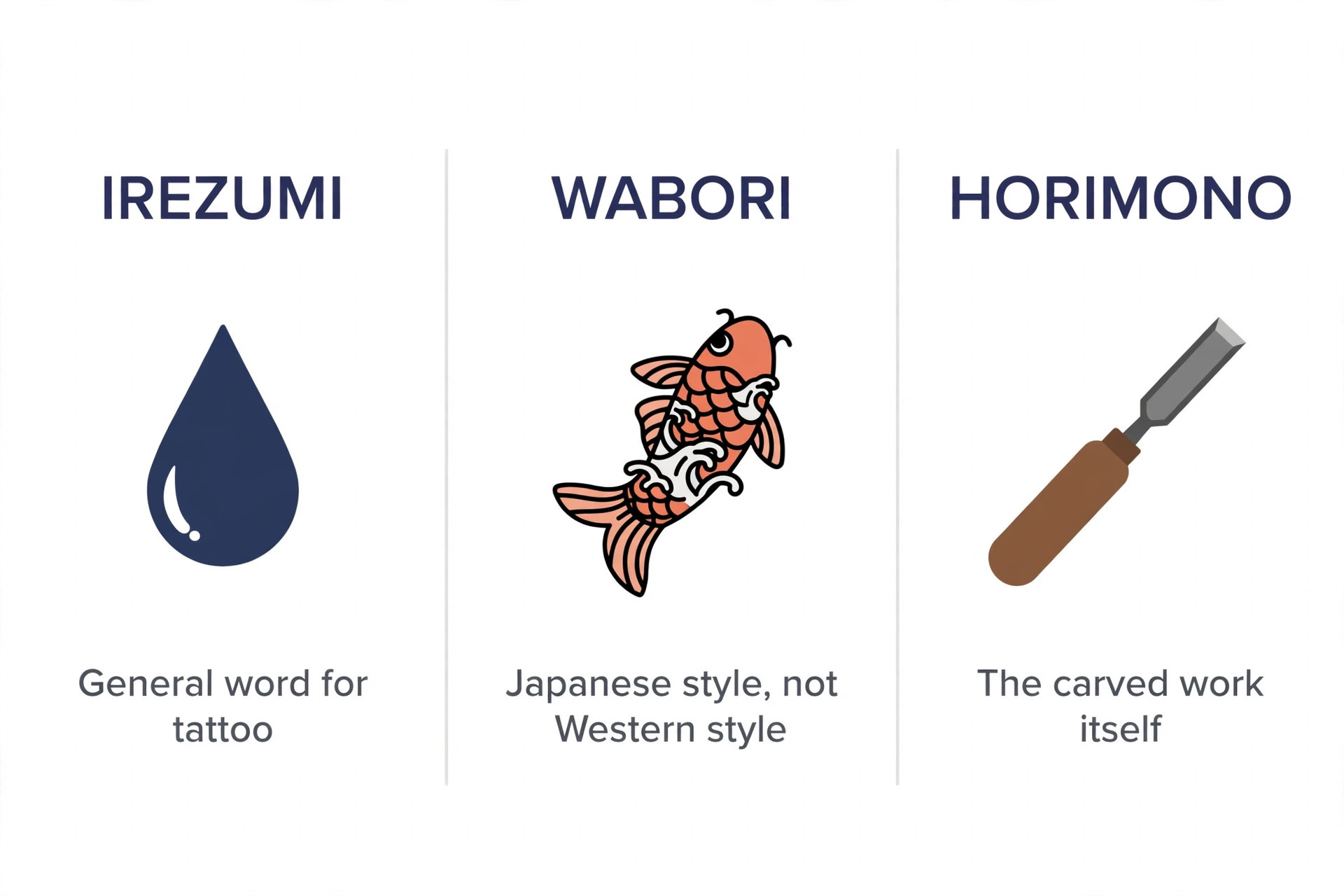
Irezumi is the broadest of the three words, and its parts explain why. Break it down and you get a form of the verb for putting something in, joined to the word for ink. Inserting ink is a plain, physical description of what tattooing is, and plain descriptions tend to become the general word for a thing. The dictionary entry for irezumi on Jisho lists tattoo and tattooing as its core senses, which is exactly the job a general word should do. When a Japanese speaker needs the ordinary word for a tattoo, this is the word family that does that work.
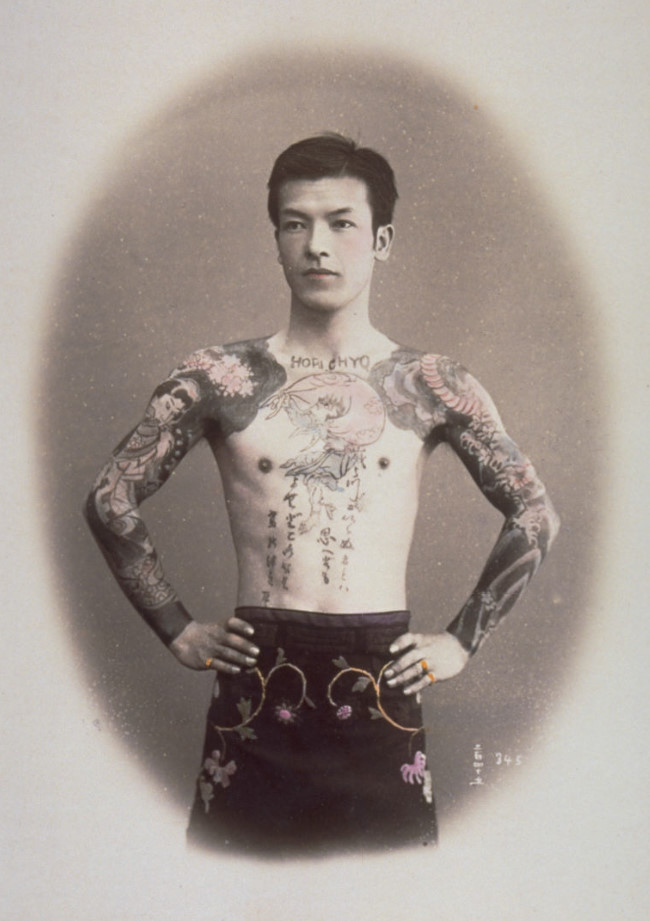
In English, the word has picked up a second, narrower glow. Because English speakers usually meet irezumi through photographs of large traditional Japanese work, the word often points, in English use, to that full-body tradition specifically: the back pieces, bodysuits and sleeves built as one composition. The Pitt Rivers overview reflects that English habit, presenting irezumi as expansive work covering much of the body. Neither use is wrong. Inside Japanese, the word is general. Inside English tattoo talk, it often carries the traditional large work with it, and a careful writer signals which sense is in play.
Two cautions belong with this word. First, irezumi is not a technique. The hand method of tattooing has its own vocabulary, and treating irezumi as the name of a method collapses a word for the thing into a word for how it was made. Second, irezumi is not a quality mark. It does not certify that a piece is traditional, well made or done in Japan. It names the tattoo. The survey of irezumi history and terms at Japan Nakama is useful here precisely because it treats the word as the entry point to a whole culture of tattooing rather than as a badge, and the Jisho irezumi entry keeps the plain dictionary sense in view at the same time.
Wabori: the Japanese style, set against yobori
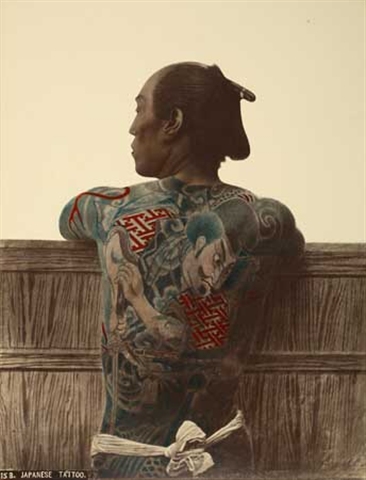
Wabori is a style word, and it is built from a contrast. Its first part, wa, marks something as Japanese. Its second part comes from the carving root that this guide will return to shortly. Put together, the word says something close to Japanese carving, and in tattoo use it names tattooing done in the Japanese style. The dictionary entry for wabori on Jisho gives the sense of Japanese-style tattooing, and the word cannot be fully understood without its partner. Yobori, built with the part that marks something as Western, names Western-style tattooing. Wabori exists because yobori exists. The pair sorts tattooing by style family, the way a kitchen might be sorted by cuisine.
The style word also explains why wabori appears so often in shop names, artist bios and portfolio headings. An artist who lists wabori is making a style claim, telling clients which tradition the work follows. The V&A museum documents the woodblock print culture that supplied so much of that tradition’s visual language, and a Khan Academy lesson on those prints shows the same subjects and weather that still define the style on skin. When you see those prints, you are looking at the reference library the wabori style still draws from, which is why the style can be recognized across oceans and centuries.
One more distinction keeps this word clean. Wabori is not the name of the finished object in the way horimono is, and it is not the general word in the way irezumi is. If a sentence is about methods, subjects, composition or tradition, wabori is usually the right tool. If a sentence is about tattooing in general, it is usually the wrong one. The Jisho wabori entry keeps that style sense front and center, and the Japan Nakama survey shows the word sitting alongside the other terms rather than replacing them.
Horimono: the carved thing itself
Horimono is the most concrete of the three words, and the most easily missed. Its first part is the carving root, to carve or engrave. Its second part, mono, means a thing or an object. A horimono is, at root, a carved thing. Outside tattooing, the word is used for engravings and carved designs on objects such as blades and lacquerwork, where a design has been cut into a surface. The dictionary entry for horimono on Jisho carries both the engraving sense and the tattoo sense, and that double life is the whole point. The word travelled from carved objects to carved skin because the underlying image, a design cut into a surface by a skilled hand, is the same.
Used for tattooing, horimono points to the work itself as a made object. Where irezumi names the tattoo in general and wabori names the style, horimono names the piece as a piece: this carved work, on this body, made by this hand. That is why the word often appears where the work is being admired, collected, photographed or discussed as art rather than as a service. The general reference overview of irezumi notes horimono as another term for traditional Japanese tattoos with a slightly different significance, and that slight difference is exactly this shift from the act and the style toward the resulting object.
In practice, horimono is the word you will hear least in casual English tattoo talk, and that rarity causes its own mix-up. Readers sometimes assume the least familiar word must be the most correct or most traditional one, and start using horimono for everything. Resist that. The word earns its place when the work itself is the subject. The Jisho horimono entry shows the engraving sense sitting first in the word’s life, and remembering that order, carving first, tattoo second, keeps the word’s flavor accurate.
Why the hori root keeps appearing
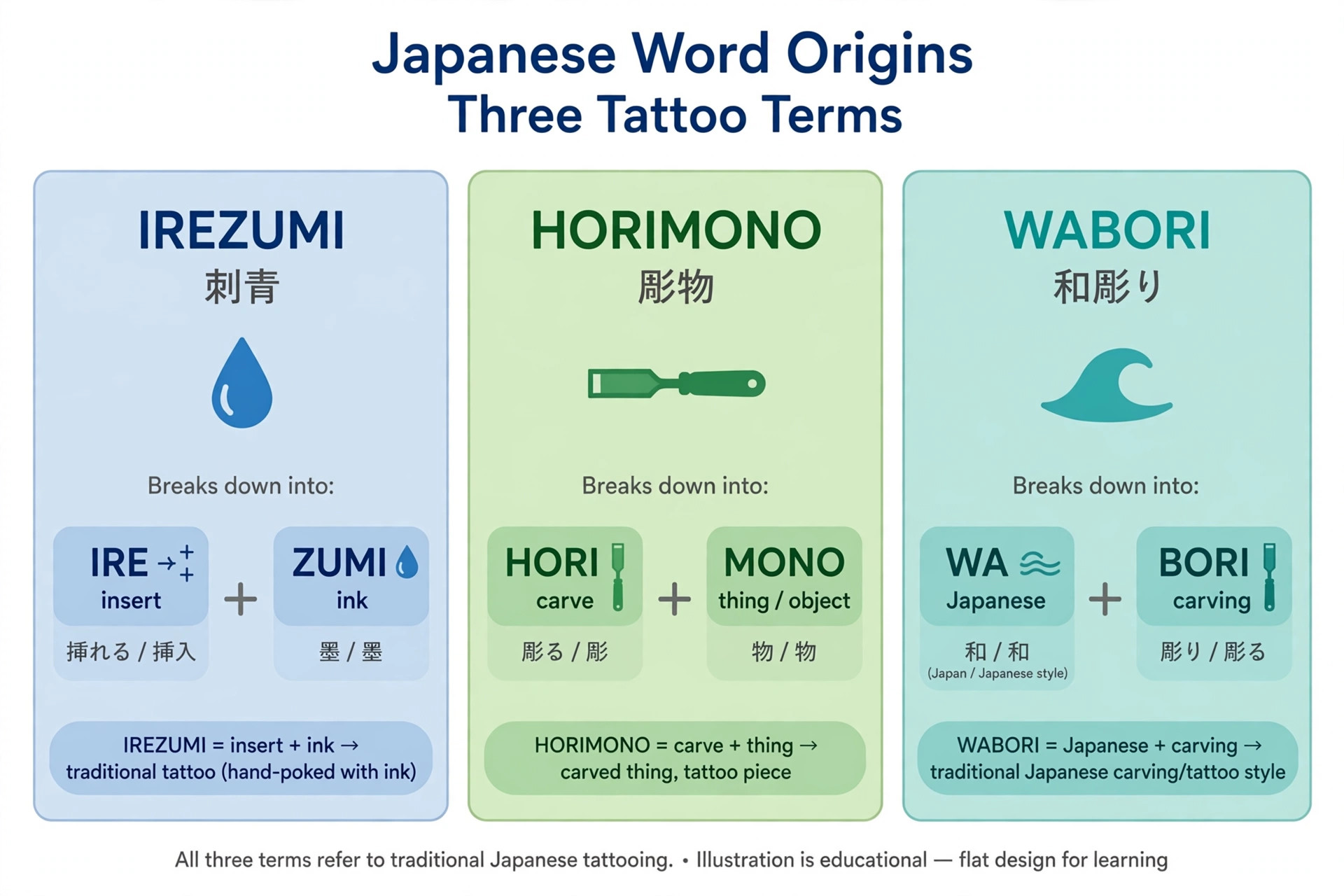
Readers who meet these words together usually notice the shared piece before they notice anything else. Hori, the carving root, appears inside horimono, inside wabori through its bori form, and inside the professional names of traditional tattooers, whose titles are built on the same root. That is not a coincidence, and it is not three separate borrowings. It is one craft image, carving a design into a surface, running through the whole vocabulary like a thread.
The collections that document the tradition show that craft continuity. The holdings of the UBC Belkin collection and the photographs preserved in the Belkin collection records sit beside the print history in the V&A woodblock article and the Khan Academy ukiyo-e lesson, while the photographs in the Commons irezumi archive show the carved look on skin itself.
For a beginner, the practical payoff is simple. When an unfamiliar tattoo word contains that carving sound, it is probably talking about the work, the style or the worker, not about ink in general. That single pattern sorts a surprising amount of vocabulary on first meeting, including words this guide does not cover. It also helps when browsing free tattoo designs and meanings, where Japanese subjects appear beside many other traditions and the style words are doing quiet sorting work in the background.
How the three words overlap
Overlap is where most arguments start, so it helps to picture one real piece and describe it three honest ways. Take a full back piece: a hero in armor, cloud bands across the shoulders, waves at the base, done in the traditional manner. Call it irezumi and you are naming it as a tattoo, with the English suggestion of the large traditional tradition attached. Call it wabori and you are naming its style, Japanese in method and look, as opposed to Western-style work. Call it horimono and you are naming it as a carved work, a made thing worth regarding the way you would regard an engraving. Three sentences, three different claims, no contradiction anywhere.
The overlap runs in one direction more than the others. Almost any traditional Japanese piece can carry all three words at once. The reverse does not hold. A small Western-style tattoo is irezumi in the general Japanese sense, but it is not wabori, because the style is wrong, and horimono would be a stretch outside the traditional carved-work context. Knowing which direction the overlap runs prevents the most common error, which is treating the broadest word and the narrowest word as if they covered the same ground.
Context decides which word a speaker reaches for, and context is usually visible. Museum and archive writing reaches for the general word, as the Pitt Rivers page and the Commons category both show. Studio and style writing reaches for wabori. Writing about the work as an object, its making and its keeping, is where horimono appears. Readers who want to see how the style words play out on real skin across tones and builds can follow that thread into wabori on different skin tones and wabori shading vs outline, where the style, not the vocabulary, is the subject.
Which word to use when
Choosing the word is a small decision tree, and it takes about five seconds once you have run it a few times. First question: am I talking about tattooing or a tattoo in general, with no style claim attached? Use irezumi, or simply the English word tattoo, which is often the clearest choice of all. Second question: am I making a style claim, saying the work follows the Japanese tradition rather than the Western one? Use wabori, and be ready for its partner yobori to appear in the same conversation. Third question: am I talking about a specific finished work as a made, carved thing? Use horimono.
A few worked examples fix the pattern better than rules do. Writing a caption for a photograph of a large traditional back piece for a general audience: irezumi is the natural word, and it is the word the irezumi reference overview would lead you to. Describing what an artist specializes in on a booking page: wabori, because the claim is about style. Discussing a completed piece as part of a collection of photographs or as an artwork with a maker and a history: horimono starts to fit, the way it fits in the horimono dictionary entry where the carved object comes first.
When in doubt, choose the plainer word and add one clarifying phrase. Beginners collecting first ideas in free tattoo designs for beginners will meet all three words in the wild, and this decision tree is the tool to bring along.
Common mix-ups, sorted one by one
The first mix-up is treating irezumi as a technique name. It is the general word for tattoo, built from inserting ink, and the hand technique has separate vocabulary. Calling the method itself irezumi is like calling the act of painting by the word picture. The Jisho entry for irezumi gives the tattoo senses, not a method, and that dictionary plainness is the correction.
The second mix-up is using wabori for any tattoo done in Japan or on a Japanese subject. Wabori is a style claim, defined against yobori, Western-style tattooing. A portrait, a script piece or a Western-style design does not become wabori by location or by subject alone. The Jisho entry for wabori anchors the style sense, and the pairing with yobori is what keeps the word honest.
The third mix-up is using horimono as a fancy synonym for tattoo in every sentence. Horimono points to the carved work itself, with its engraving history behind it. Used for everything, it loses the very distinction that makes it worth knowing. The horimono entry on Jisho shows the engraving sense and the tattoo sense side by side, which is a reminder that the word always carries the carved object with it.
The fourth mix-up is assuming the three words rank quality or authenticity. None of them certifies anything. A mediocre piece can be described with all three words and an excellent piece with none. Quality lives in the work, in healed lines and sound composition, the same qualities that decide whether a design chosen from free printable tattoo designs survives contact with real skin. Vocabulary describes. It does not grade.
The fifth mix-up is forgetting that English use and Japanese use have drifted apart. In English, irezumi often implies the traditional large work. In Japanese, the word is broader and more ordinary. Neither side is using the word wrong, but a reader who carries the English implication into a Japanese context, or the other way around, will misread sentences that were clear to their writer. The museum framing at Pitt Rivers is English-facing, while the dictionary framing at Jisho is Japanese-facing, and comparing the two is the fastest way to feel the drift for yourself.
How to talk to an artist using these words
In a consultation, these words are tools for being understood, not tests to pass. An artist hears wabori and understands a style request: Japanese subjects, traditional composition, background treated as part of the design. An artist hears that you want a large irezumi piece and understands scale and tradition in general terms. Horimono is the word least likely to be needed in a booking conversation, and using it naturally, about the finished work you hope to carry, signals that you see the piece as a made thing rather than a product pulled off a shelf.
The words also help you ask better questions. Ask whether an artist’s wabori work is done by hand, by machine, or both, and you have separated style from technique in one sentence, which is a distinction this whole guide rests on. Ask how the background will be planned, and the answers will connect to the composition questions covered in free tattoo stencils and patterns, where placement and planning decide how a design meets a body. Ask to see healed work, because healed work is where carved lines either hold or soften, and the American Academy of Dermatology’s guide to how tattoos age explains why that softening is a normal part of a tattoo’s life rather than a surprise.
Placement language benefits from the same care, so pair the style word with the body talk found in free tattoo designs for arms if an arm piece is the plan. If you are still gathering references, the roundup in find free tattoo designs and the preview tools in free tattoo design apps and generators give you images to point at, and a picture plus one accurate word is a stronger consultation opening than a paragraph of borrowed vocabulary. The AAD guide to tattoo aging is also worth a read before a large piece.
Our view
Three words looked like a muddle because each one was quietly answering a different question. Irezumi answers what is it, wabori answers what kind is it, and horimono answers what shall we call the carved work itself. Learn those three questions and the words stop competing. You will read captions more accurately, talk to artists more clearly, and describe your own piece, if you get one, the way the tradition itself would describe it. That is all terminology is for, and it is enough.
Frequently asked questions
Are irezumi, wabori and horimono interchangeable?
No, although one traditional piece can honestly be described by all three. Irezumi is the general word for tattoo, wabori names the Japanese style as opposed to Western-style yobori, and horimono names the tattooed work itself as a carved thing. Interchangeable use loses the distinction each word exists to make.
Which word should a beginner use first?
Irezumi, or simply the English word tattoo. It is the broadest and most widely recognized of the three, and it makes no style claim you might not intend. Add wabori when you are specifically talking about the Japanese style, and save horimono for talking about a finished work as a made object.
Does wabori mean the tattoo was done by hand?
No. Wabori is a style word, not a technique word. Japanese-style work can be done by hand, by machine, or with both in the same piece. The hand method has its own vocabulary, and keeping style and technique in separate columns is one of the main points of sorting these terms.
Why does horimono also mean engraving on objects?
Because that is the word’s original home. Horimono names carved and engraved designs on surfaces such as blades and lacquerwork, and the tattoo use borrows that image: a design worked into a surface by a skilled hand. The tattoo sense grew out of the engraving sense, not the other way around.
Is it disrespectful to use these words as a non-Japanese client?
Used accurately and modestly, no. Artists generally welcome clients who have taken the trouble to learn what the words mean. The respectful move is accuracy, using each word for its own job and not dressing ordinary requests in borrowed vocabulary to sound impressive. When unsure, plain English plus one accurate term is always a good combination.
Keep exploring Tattoos4Everybody
The words are sorted. The hub guide covers the style itself: its subjects, its planning and how a full piece comes together.
Sources
- Pitt Rivers Museum — Body Arts: Japanese irezumi
- V&A museum — Japanese woodblock prints (ukiyo-e)
- irezumi history and terms — Japan Nakama
- Wikimedia Commons archive — Category: Irezumi
- Khan Academy lesson — Ukiyo-e prints
- UBC Belkin collection — Japanese tattoo photographs
- horimono on Jisho — Jisho dictionary entry: horimono
- irezumi on Jisho — Jisho dictionary entry: irezumi
- wabori on Jisho — Jisho dictionary entry: wabori
- irezumi overview — Irezumi, general reference overview
- how tattoos age — American Academy of Dermatology